


By Enisa Murseli Gjokaj
When we talk about diaspora, we usually think of organized communities, cultural associations, professional networks, and strong ties to the country of origin. However, not all migrants experience diaspora in the same way. Some live in a space between legal systems, national identities, and state institutions. They are part of the community, but not always fully recognized by institutions. This is what I call the invisible diaspora.
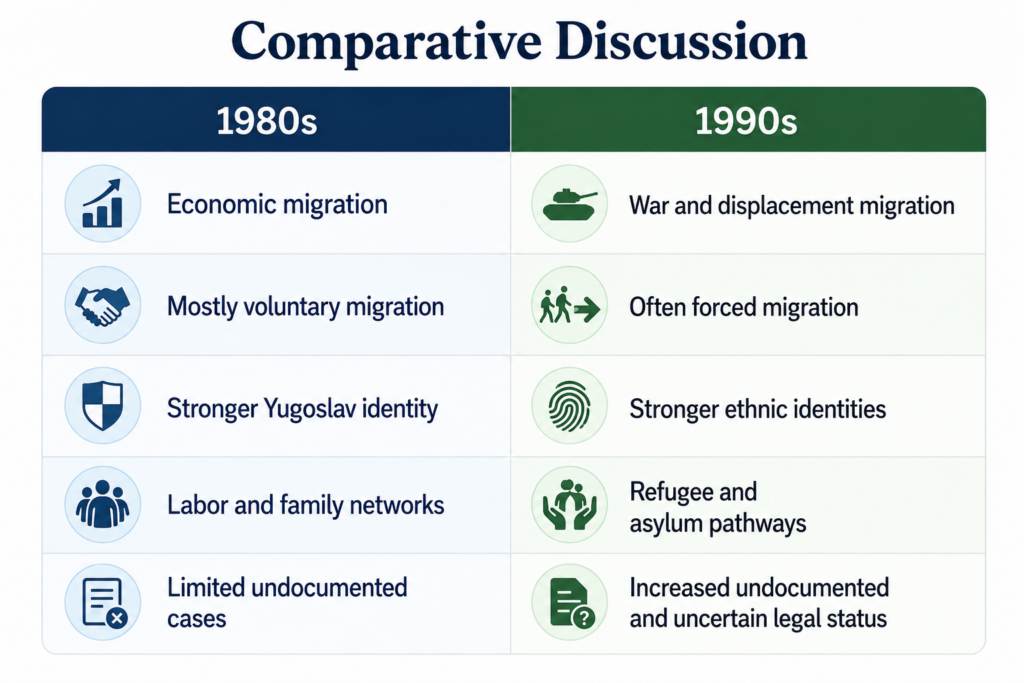
Migration from the Balkans to the United States during the 1980s and 1990s provides a meaningful example for understanding this phenomenon. While many migrants in the 1980s emigrated for economic reasons and in search of better opportunities, the migration waves of the 1990s were shaped primarily by war, forced displacement, and the breakup of Yugoslavia. Although the historical circumstances differed, both periods produced communities living between more than one identity and more than one institutional system.
During the 1980s, migration from Yugoslavia to the United States was largely an economic project. Migrants left to secure employment, improve their incomes, and create better opportunities for their families. Many relied on family and social networks established by earlier generations of immigrants. At that time, a Yugoslav identity often carried particular significance and, for many migrants, ethnic affiliation was not as strongly emphasized as it would become later.
The situation changed dramatically during the 1990s. The wars in Bosnia and Herzegovina, Croatia, and Kosovo generated large waves of refugees and displaced persons. For many families, migration was no longer an economic choice but a necessity for survival. This period brought not only large-scale population movements but also profound transformations in how people understood their national, ethnic, and political identities.
In the United States, significant Bosnian, Serbian, Croatian, Albanian, and other Balkan communities emerged. Cities such as St. Louis, Chicago, New York, and Detroit became important centers of diaspora life. These communities established cultural organizations, religious institutions, and support networks that helped migrants adapt to their new reality without losing connections to their countries of origin.
For Albanians from Kosovo, Albania, North Macedonia, and Montenegro, the diaspora in the United States has played an important role not only in preserving national identity but also in supporting political and social processes in their homelands. The contribution of the Albanian diaspora has been evident through economic investments, humanitarian activities, political advocacy, and the promotion of Albanian culture abroad.
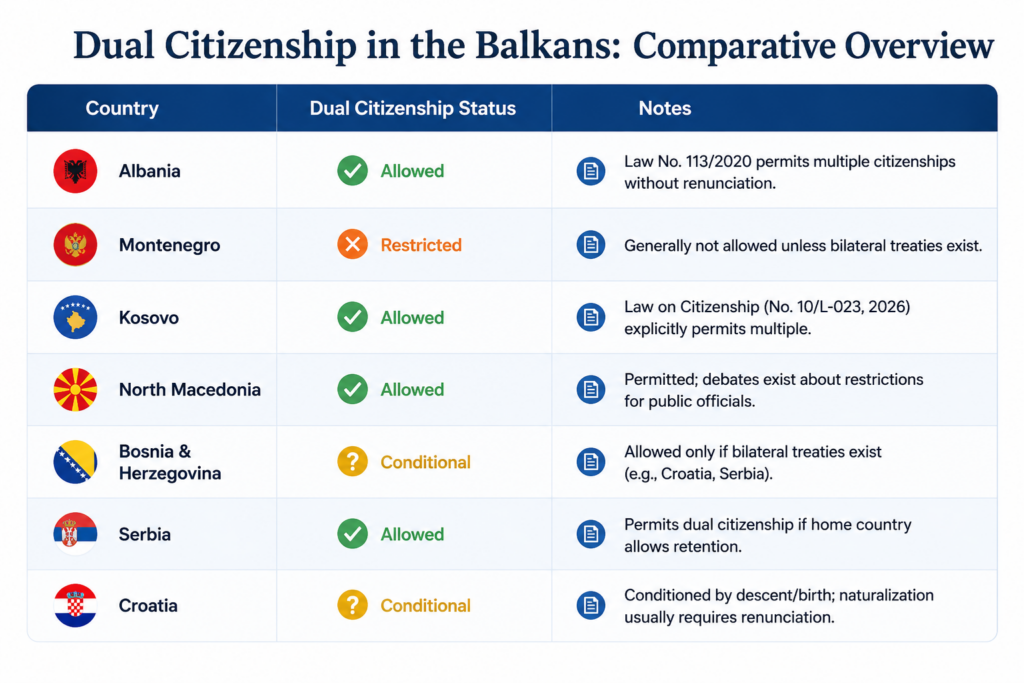
However, not all migrants have experienced the same level of security and recognition. Some have faced challenges related to documentation, residency status, citizenship, or administrative procedures. For these individuals, social and cultural belonging has not always been accompanied by full institutional recognition.
This is where the concept of the invisible diaspora emerges. The invisible diaspora includes individuals who maintain strong ties to their communities and countries of origin while simultaneously facing legal or administrative uncertainty. They participate in community life, contribute to the economy and society of the countries where they live, and preserve their cultural identities, yet they do not always enjoy full recognition from state institutions.
This concept helps us understand a dimension of migration that often remains outside public attention. Discussions about diaspora typically focus on integration, economic success, or cultural preservation. Far less attention is given to migrants’ relationships with administrative systems and the impact that legal status can have on their everyday lives.
The experience of the Balkans shows that migration is not merely a story of crossing borders. It is also a story of identity, belonging, and the search for recognition. In an increasingly globalized world, where people often live between more than one state, more than one culture, and more than one legal system, the concept of the invisible diaspora offers a new way of understanding migrant experiences.
The Albanian and broader Balkan diaspora in the United States continues to serve as an important bridge between countries of origin and American society. It demonstrates that belonging is defined not only by documents or state borders, but also by human connections, collective memory, and active participation in community life. Yet, to fully understand the experience of migration, we must look not only at those who are visible in statistics and institutions, but also at those who live in the spaces between them: the members of the invisible diaspora.
About the Author
Enisa Murseli Gjokaj is a researcher specializing in migration, diaspora, and identity studies. Her research interests include Balkan migration, the Albanian diaspora, citizenship, relationships between migrants and state institutions, and the role of women in diaspora communities. In her work, she pays particular attention to the contributions of migrant women in preserving cultural identity.